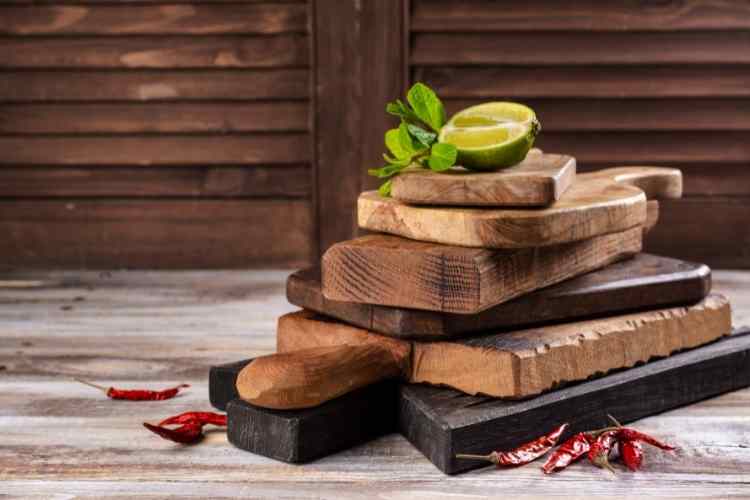

How many hours of work do you put in at the kitchen table on a typical day? Even if it’s only 15 minutes, this time builds up to a long period of time. Cutting boards are an essential part of any kitchen, and you deserve to spend your time with one that you like.
Even with something as basic as a cutting board, there are a slew of things to keep in mind. Cutting boards seem to be innocent, but poor usage may make them one of the kitchen’s most contaminated things.
When purchasing a cutting board, what to look for.
First, take a breather. You may have heard a variety of stories about the dangers of various cutting boards. As long as you follow the Recommended Food and Sanitation Practices (which we cover, don’t worry), any cutting board material is safe.
This is a list of things to keep in mind while purchasing a board:
- Is using a knife convenient? It takes longer for a knife to dull on a hard surface.
- Is it simple to maintain? If that’s essential to you, can it be washed in the dishwasher?
- Whether or not it’s simple to maintain, is it necessary to use onboard oil on a regular basis?
- What’s the price? What is the total cost to you?
- How long-lasting is this? In what frequency will you have to replace it?
- Please tell me how large this is. What’s your role?
Cutting boards constructed from bamboo
It’s a more environmentally friendly alternative than wood to use a bamboo cutting board like this one from Royal Craft Wood. The bamboo board will last a long time if you leave it alone. Cutting boards made of bamboo may be purchased for as low as $10 or as much as $150, depending on their size.
In terms of cutting board finishes and edges, bamboo cutting boards come in a wide range of options. The last grain is an additional fee. Dealing with bamboo requires a sharper knife than working with wood since bamboo is a harder substance. It’s possible that these trees may not be the ideal choice if you are on a restricted budget.
For best results, avoid using the dishwasher and grease your bamboo cutting board on occasion.
Cutting boards for wood with a beveled edge
Each kind of edge on a wooden cutting board has its own advantages and disadvantages.
Extremely fine grain
A textured cutting board is constructed of wood that has been sanded and smoothed. This signifies that the top of the board is covered with long wood fibers. Cutting boards made of edgebanding are the most prevalent since they are generally the cheapest.
Long grain wood boards are more prone to being scratched by knife blades due to their lack of pliability beneath the blade. In the analogy of cutting wood fibers into an edge board, this is what you’re doing. Edge boards, on the other hand, are regarded to be a little firmer for knives than edge boards since they are made of wood.
The final grain
To create a wood chopping board, transverse pieces of wood are fused together. This implies that the rings of the tree may be seen from the top of the board rather than from the side (length). It is common for end-profiled boards to be several inches thick and to cost more than edge-profiled boards since they are more difficult to make.
Because the wood fibers of the end profile boards heal more quickly after usage, the board has fewer grooves. The end fiber cutting board, on the other hand, is more pliable. Because wood fibers have a greater rebound, the knife handles are gentler.
Fiberboard, on the other hand, is more vulnerable to moisture since it is made up of a large number of wood fragments bonded together. The reason for this is that woodcutting against the grain is more water-absorbing. In order to keep a cutting board free of microorganisms, it must be absorbent.)
Over time, the seams of a butt board might dissolve, allowing germs to enter and thrive. When it comes to protecting your cutting boards from moisture and cracking, mineral oil or cardboard cream may assist. This is particularly true when cutting end fibers on a chopping board.
There is a little “stiff” edging board in comparison to the knives, so what about that?
Even if you don’t cut much, it may make a tremendous difference. Using a hardwood cutting board is preferable to using glass, Corian, or metal cutting board.
Maple, oak, and cherry cutting boards
When handled with care, wood chopping boards are safe, gentle on blades, and last a long time. Wooden cutting boards may cost anywhere from $20 to $200, depending on the quality of the wood and the level of workmanship.
A cutting board constructed of thick hardwoods such as beech or maple is the most durable. The wood’s small pores make it harder for blades to develop grooves where germs may hide. The wood contains naturally occurring antimicrobial compounds such as tannins.
Do not put wooden cutting boards in the dishwasher while cleaning them. It’s all your fault. Cutting boards made out of hardwood are vulnerable to heat and detergents that are too harsh. Here are a few pointers for caring for your wooden cutting boards.
Plastic cutting boards
Many different sizes and styles are available for plastic cutting boards. As an alternative to heirlooms, this is an excellent option since the knives won’t dull and they won’t warp or shatter if left out in the weather, making them ideal for use in the kitchen. Costs for basic versions start at about $10, while the more costly commercial ones may cost as much as $100.
A wooden or bamboo cutting board will survive longer than a plastic one in the long term. Cutting self-healing wood planks results in a somewhat bouncy cut.
Cutting on a plastic cutting board leaves a lasting mark. A cutting board with more grooves may provide more places for bacteria to hide. Plastic cutting boards may not be as bacteria-free as previously believed, and wood cutting boards may actually be superior at avoiding the transmission of germs!
Despite what you would think, plastics are not all the same. Compared to conventional polyethylene, HDPE is more pliable (PE). For a cutting board, if the plastic used to make it is listed, it will survive longer than a standard board.
When there are several knife marks on your plastic cutting board, it’s time to replace it. The more nooks and crannies, the more difficult it is to clean and disinfect. It doesn’t matter how often you use your plastic cutting board if the surface is rough and shaggy.
If you’re looking to wash plastic cutting boards in the dishwasher, you’ll get conflicting recommendations. It is acceptable to use the dishwasher, according to the USDA, although some polymers may be weakened by the heat, resulting in the closure of the grooves on the board, which produces nooks in which bacteria can grow. Ugh! Using the manufacturer’s directions for cleaning is the best way to go about it.
Made of a composite material such as stainless steel
Using a cutting board made of composite materials is the best of all possible worlds.
We’ve been using cutting boards made of Richlite composite paper for a long time. In spite of the fact that they are not as gentle on your blades, they are dishwasher safe and stain resistant, don’t require any oiling, and come in a broad variety of patterns.
When it comes to cutting boards, they are the best of all worlds: sturdy and easy to clean. They cost between $20 and $60.
I am cutting down on the materials used to make a cutting board to minimize injury.
Cutting boards consisting of glass, marble, granite, or Corian are not recommended. Because these surfaces are so harsh, they will soon dull your knife.
Other ideas to assist you in finding the best cutting board for your needs are provided here.
Multiple cutting boards are required. Use separate cutting boards for various meals if you are worried about cross-contamination. In order to make it simpler to identify between different types of meats, you may purchase sets of color-coded plastic cutting boards.
For different purposes
Keep a variety of cutting boards on hand for varied tasks, such as chopping cheese or fruit, and a bigger one for larger goods like entire chickens or winter squashes. F.e. cutting board with compartments could be used as a serving platter board:
Preparation will go quicker if you have a lot of areas to work in.
If the cutting board does not have non-slip feet on the bottom, it may easily fall over. Using a moist paper towel beneath a cutting board may also be helpful.)
If you’re becoming taller, you’ll need a cutting board that’s a little thicker. You won’t have to bend over as much since the work surface will be elevated. On days when you have a lot to prepare, ergonomics may make a major difference in your comfort! A couple of thicker cutting boards may also be stacked on top of each other, which is what I use when I work in a restaurant.
A chopping board that isn’t too thick can help if you’re short
Keep your feet on the ground! Get fed up with the constant drips on your counter. You’ll want a board with a juice groove on it. When cutting juicy fruits or vegetables, such as tomatoes or melons, or when slicing hot, cooked meat, a trench is formed along the perimeter of the cutting board. A sap groove that is too shallow or thin is of little value and is only decorative.
When it comes to cutting boards, avoid cutting boards that have handles built-in. While it’s true that they’re easy to grasp or hang on a wall for storage, they may also fall into an open space, making a little mess. The handle drastically limits the cutting board’s size since you can’t utilize this region as a cutting surface.
Flexible plastic cutting boards are flimsy and short-lived, but their flimsiness may be used to your advantage: you can bend them into a funnel to easily transfer food from a pot or dish to another.