
Abstract: The coal mine belt conveyor often fails during operation. For example, the deviation of the belt can easily cause problems such as material scattering, belt wear, and deviation of the walking direction, which brings difficulties to the subsequent processes and many other problems. This paper discusses the common faults such as abnormal noise and deviation of the conveyor belt of coal mine belt conveyor, and proposes corresponding solutions.
Belt conveyors are widely used in coal mines. Therefore, it is very important to prevent accidents and eliminate belt conveyor accidents.
1. Conveyor belt abnormal noise.
1.1 Abnormal noise of redirecting drum and driving drum
When the reversing drum and the driving drum are working normally, the noise is very small. If abnormal noise occurs, it is generally due to the damage of the bearing, which causes a rattling sound at the bearing seat, and the bearing needs to be replaced at this time.
1.2 The noise when the idler is seriously off-center
When the idler often makes abnormal noise and is accompanied by periodic vibration during the belt conveyor is running. The main reasons are: First, the thickness of the seamless steel pipe used to manufacture the idler is not uniform, resulting in a large centrifugal force; the second is that the center of the bearing hole and the center of the outer circle have a large deviation when producing, resulting in a large centrifugal force.
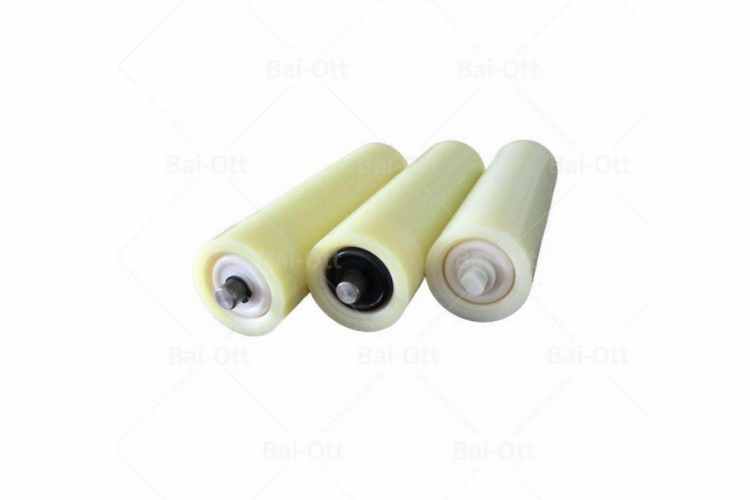
Read More:High Quality Belt Conveyor Support Drive Roller
1.3 Noise when the two shafts of the coupling are not concentric
At the high-speed running end of the drive device, the abnormal noise from the coupling between the motor and the reducer or the coupling with the brake wheel is often accompanied by vibration of the same frequency as the motor’s rotation. The position of the motor reducer should be adjusted when have this noise.
2. belt conveyor conveyor belt deviation
2.1 Adjust the load bearing roller group
When the conveyor belt deviates in the middle of the entire conveyor machine, which can be adjusted by change the position of the idler group. During the production of idlers, the mounting holes on both sides of the idler set has been machined into long holes for adjustment.
The specific method of adjustment is: move the side of the idler set deflected forward in the side of the conveyor belt running direction, or move the other side backward; if the belt deviates in the upward running direction, the idler set lower position should move to the left, and the upper position should be moved to the right.
2.2 Installation of self-aligning idler set
There are many types of self-aligning idler sets, such as intermediate shaft type, four-link type, vertical roller type and so on. The principle is to use the blocking roller to rotate in the horizontal plane to stop the transverse thrust, so that the belt is automatically centripetal, so as to achieve the purpose of adjusting the deviation of the belt.
2.3 Adjust the position of the driving drum and the reversing drum
The adjustment of the driving drum and the reversing drum is the key link in the adjustment of the belt deviation. If the deflection is too large, it will inevitably lead to deviation. The adjustment method is similar to adjusting the idler set. For head pulleys, if the belt runs off to the right side of the pulley, the right bearing housing should move forward. If the belt deviates to the left of the drum, the left bearing housing should move forward. Correspondingly, the left bearing seat or the right bearing seat can also be moved backward. The adjustment method of the tail roller is just the opposite of that of the head roller. Through repeated adjustment, until the belt is adjusted to a more suitable position.
2.4 Adjustment of tension
When using screw tensioning or hydraulic cylinder tensioning, the two bearing seats of the tensioning drum should be translated at the same time to ensure that the axis of the drum is perpendicular to the longitudinal direction of the belt. The specific adjustment method is similar to the adjustment at the drum.
2.5 Adjustment of deviation of belt conveyor in two-way operation
The adjustment of the belt deviation of the two-way belt conveyor is relatively more difficult than the adjustment of the deviation of the single-direction belt conveyor. One direction should be adjusted first, and then the other direction should be adjusted. When the degree of adjustment is large, carefully observe the relationship between the belt movement direction and the deviation trend, and adjust one by one. The emphasis should be placed on the adjustment of the driving drum and the reversing drum, followed by the adjustment of the idler and the material blanking point.
3. The belt conveyor spreads the material
The conveyor spreads the material is a common problem, there are many reasons for it, the focus of the solution is to strengthen daily maintenance and maintenance.
3.1 Material spread when the concave part of belt is dangling
When the radius of curvature of the concave part of belt is small, the belt will be gangling, and the groove of the belt will change. Since the belt has left the grooved idler set, the groove angle becomes smaller, causing part of the material spread. Therefore, a larger radius of curvature of the concave section should be used as much as possible in the design to avoid such situations. For example, in order to shorten the tail car, on the stacker and reclaimer equipment, the concave section here is designed as an area without arc transition.
3.2 The influence of the materials fall position at the transfer point on the deviation of the belt
The materials fall position of the material at the transfer point has a great influence on the deviation of the belt. Usually, the relative height of the upper and lower belt conveyors at the transfer point must be considered. The lower the relative height, the greater the horizontal velocity component of the material, and the greater the lateral impact on the lower belt. At the same time, it is difficult for the material to be centered so that the material on the cross section of the belt are skewed, which eventually leads to the deviation of the belt. If the material deflects to the right, the belt deflects to the left. Vice versa.
4. The shaft of the reducer is broken
The broken shaft of the reducer usually occurs on the high-speed shaft of the reducer, and usually the first stage of the the high-speed shaft of reducer is the vertical half-gear shaft.
4.1 The eccentric of high-speed shaft
When the motor shaft and the high-speed shaft of the reducer are not concentric, the input shaft of the reducer often increases the radial load and increases the bending moment of the shaft, so that the shaft will be broken during long-term operation. Therefore, its position should be carefully adjusted during installation and maintenance to ensure that the two axes are concentric.
4.2 The design strength of the high-speed shaft of the reducer is not enough
Generally, the broken shaft of the reducer occurs at the shoulder of the roller, because there is a transition fillet here, which is usually have fatigue damage. If the angle is too small, the reducer will break the shaft in a short time, and the break part surface is usually flat. When this happens, the design of the reducer should be replaced or modified.
5. Belt service life
The service life of the belt is related to the use condition and the quality of the belt. The manufacturing quality of the belt is an important factor affecting the life of the belt. Routinely, a visual inspection can be carried out to see if there are cracks, aging, etc., or whether the storage time is too long, the belt have above problems cannot be purchased.
6. The influence of the curvature radius of the convex and concave section on the conveyor belt.
6.1. The middle of the cross section of the convex belt is arched
The convex section of the belt often occurs in the middle of the belt surface, which is the middle bulges. The main reason for arching and discounting is that the tension value difference on the unit length of the middle and outer sides of the belt cross section is too large, so that the belt slides to the middle to form arching or discounting. The larger the groove angle, the smaller the curvature radius of the convex segment, and the more serious the arching and discounting.
6.2 The concave section bounces up and is deflected by the wind when the conveyor start running.If there is no material when the belt conveyor starts, the belt will spring up at the concave section. In case of strong wind, the belt will be deflected. Therefore, it is best to add a pressure pulley to the concave section of the belt conveyor to avoid the belt from bouncing or being deflected by the wind.
7. Belt slip
7.1. Conveyor belt Slippage of heavy hammer tensioning
If the conveyor belt slip When uses a heavy hammer tensioning device,counterweight can be added to solve the belt slip until the belt does not slip. But add too much will also influence belt service life because unnecessary excessive tension, so add suitable force counterweight is ok.
7.2. conveyor belt Slippage of screw tensioning or hydraulic tensioning
If the belt conveyor slip when using screw tensioning or hydraulic tensioning slips, can adjust the tensioning stroke to increase the tensioning force.
In conclusion, the conveyor belt is an important mechanical equipment in the production process. Many users have used the conveyor for many years, but the frequently maintenance of the belt conveyor are necessary . Learning the common faults of belt conveyors and their treatment methods is very beneficial to the normal use and maintenance. Therefore, it is necessary to learn the cause of failure and treatment measures of coal mine conveyor belt to improve the productivity.
If you have any questions during use or installation, please contact BAI-OTT Coveyor Belt Accessories Manufacturer.