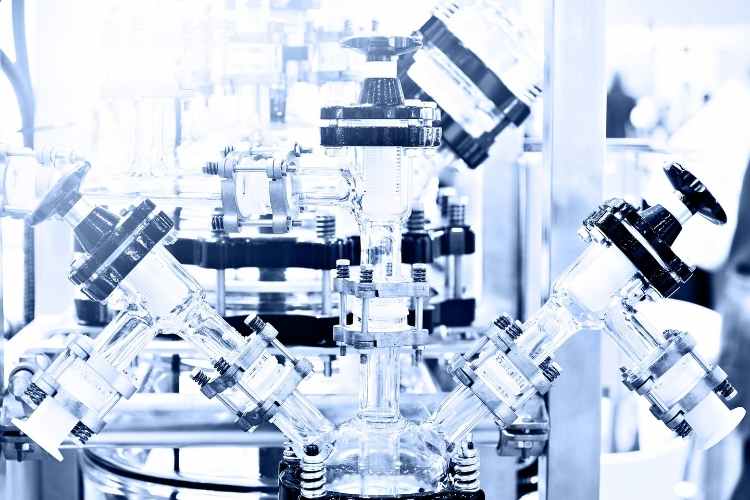

A glass reactor is a vessel popularly employed in the process industry. Glass reactors are used for various reasons, such as dissolving solids, mixing products, crystallization, batch distillation, extraction, polymerization, and much more. Glass reactors consist of glass vessels with an agitator and built-in heating and cooling systems. Liquids or solids are fed into the reactor through connectors on the top cover. The wastes usually are emptied from the bottom, and the vapors are discharged via the connections at the top. The adaptability and visibility of the glass reactor are its main features. When processing dangerous or potent substances, a single vessel system can carry out a succession of various operations without breaking containment.
There are various types of glass reactor vessels. A 2l jacketed glass reactor can be used to perform synthetic reactions on multiple materials in a temperature and vacuum-regulated environment. Each reactor has a constant pressure feeding funnel and configurable stirring rates, allowing you to add material to the vessel at a consistent and regulated speed.
The different types of chemical reactors
There are two main types of glass rectors: continuous and batch. Many aspects influence reactor design, but the thermodynamics and kinetics of the chemical processes are particularly important.
Batch reactors
The majority of reactions in a laboratory are performed in batch reactors. A test tube, flask, or beaker is filled with the reactants. They are combined, heated to initiate the reaction, and then cooled to complete the process. The finished goods are emptied and filtered if necessary. This process is also used in industry, with the main differences being reactor size and reactant amounts. After the reaction, the reactor is cleaned in preparation for adding another batch of reactants. Batch reactors are often employed when a corporation wishes to make various products with varying reactants and reactor conditions. These reactions can then be performed using the same apparatus.
Continuous reactor
A continuous input of reactants into the reactor at one point, allowing the reaction to occur, and then withdrawing the products at another point is an alternative to a batch process. Reactants and products must flow at the same speed. A continuous process can be considered a water softener, even though continuous reactors are rarely utilized in the laboratory. A tube carrying an ion-exchange resin is used to filter hard water from the mains. The reaction occurs down the tube, and soft water flows out the other end.
A laboratory glass rector allows the study of chemical processes in progress. Laboratory glass reactors are corrosion-resistant and suited for atmospheric pressures/vacuum. Invest in automated lab reactors and parallel glass reactors for high productivity, precision, and complete repeatability.
Composition of a glass reactor vessel
Glass reactors are made up of borosilicate glass. Because of its capacity to tolerate high temperatures and pressures, glass is employed to construct the reactor. In the chemical process, multiple chemicals are utilized. The main body, the top section with connecting nozzles and manway, baffles, dip pipes, agitator with mechanical seal, tank outlet valve, and jacket for heat transfer make up a glass-lined reactor. Smaller components such as exploding discs and sight glasses are typically employed for pressure relief and visibility.
How to buy a high-quality glass reactor vessel
One needs to make various considerations when buying a high-quality glass reactor vessel. For instance, when purchasing a glass reactor, consider whether the other firm is official and provides excellent after-sales support.
Listed below are some of the factors to consider when buying a glass reactor vessel
- The strength of the manufacturer
For example, when shopping on the Internet, you will compare prices and select a more reliable manufacturer. Choosing a reputable glass reactor manufacturer ensures product quality and the most vital goods’ after-sales support. Most people who buy online understand the importance of after-sales support in ensuring the quality of the buyer’s items and safeguarding the seller’s reputation.
- Consider the product price
When buying a glass reactor machine, be cautious about the pricing. This is because quality goes hand in hand with more coins. However, ensure that you stick to your budget and don’t go too high or low. Some manufacturers offer very low prices, which can seem very appealing. However, in most cases, when the pricing is low, the product’s material may be substandard to keep costs down. Therefore ensure you get top-quality items from manufacturers that offer reasonable prices and quality.
- Inquire the kind of material to be used in the glass reactor
The mixing experiment of solid-liquid and liquid-liquid can be carried out in the laboratory chemical glass reactor vessel. Naturally, this solid must be dissolved, and any material that cannot be dissolved is agitated in the glass reactor vessel, potentially damaging the glass reactor equipment. The chemical glass reactor has excellent chemical and physical qualities and high acid and alkali resistance.
- Consider the temperatures a vessel can withstand
When buying a glass reactor, consider if the vessel can withstand high temperatures and low-temperature reactions. This is because, since the glass reactor can perform both high and low temperature reactions, it may be used for distillation and crystallization. A glass rector that can withstand both temperatures is very useful.
- Consider the materials used in the glass
The glass reactor vessel’s glass component is composed of GG17 or GG33. The stirring rod’s masticating and sealing section is made of PTFE, and the bracket is made of stainless steel, which is chemically resistant.
- Ensure it is easy to handle
The glass reactor is contained within a closed glass reactor that maintains a consistent temperature. According to the application, the stirring reaction may be carried out at normal or negative pressure, and the reaction solvent can be refluxed and distilled. The material may be emptied via the discharge port at the bottom of the kettle after the reaction is complete, which is incredibly handy to use.
Glass reactors are currently the most suitable pilot and production equipment for contemporary fine chemical plants biopharmaceuticals and novel material synthesis.#
In conclusion, buying a glass reactor vessel may seem like a daunting task. However, the above-listed tips can be a guide to ensure you get high-quality vessels at a reasonable price.