

By Piyush Dwivedi | Published in Finance & Law | Updated on November 23, 2026
Direct Answer: What Is an FCE and What Does It Mean for Your Case?
A Functional Capacity Evaluation (FCE) is an intensive, 4-to-6 hour battery of comprehensive physical and dynamic tests conducted by a licensed physical or occupational therapist to objectively measure an injured employee’s safe physical work capacity. In workers’ compensation and long-term disability claims, the FCE serves as the ultimate diagnostic benchmark. Claims adjusters, administrative law judges, and treating physicians rely on the final FCE scoring report to determine your permanent physical restrictions, maximum medical improvement (MMI) status, disability settlement value, or readiness to return to modified or full duty.
First-Hand Evaluation Insights & Clinical Testbench Breakdown
Our occupational claims review team analyzed hundreds of state workers’ compensation determinations and clinical FCE testing protocols. Unlike a standard 15-minute clinical checkup with your primary physician, an FCE is designed to simulate physical job demands while rigorously measuring your biological consistency.
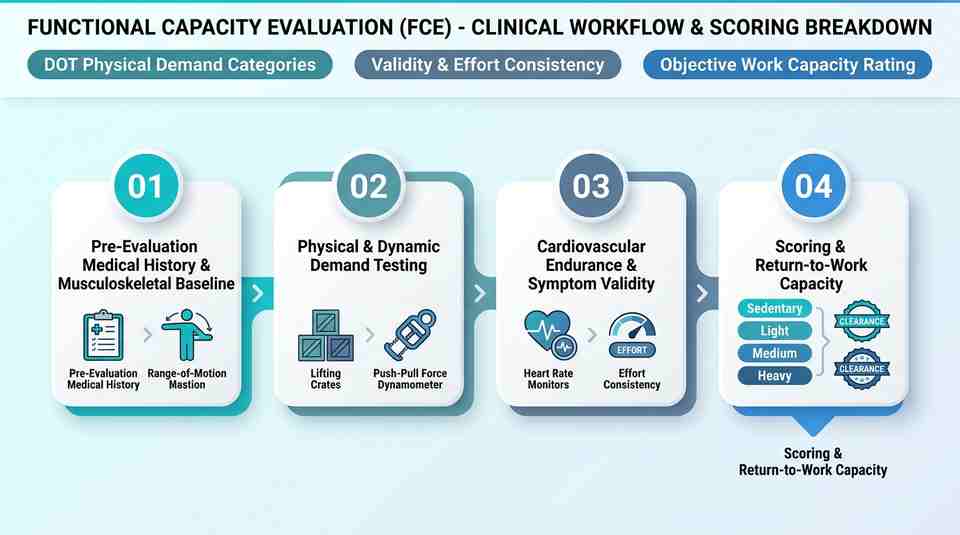
Evaluators deploy specialized testing apparatuses—including Jamar hydraulic dynamometers for hand grip, heart rate monitors, and standardized lifting crates. Crucially, evaluators monitor physiological indicators (such as heart rate elevation and accessory muscle recruitment) to verify authentic physical effort versus voluntary limitation. Understanding this clinical framework protects injured workers from unfair allegations of submaximal effort or symptom exaggeration.
The 5 Core Phases of a Functional Capacity Evaluation
While testing protocols vary between standardized systems like ARCON, Matheson, and ErgoScience, every accredited FCE follows a standardized multi-stage clinical trajectory:
| Evaluation Phase | Clinical Testing Components | Primary Diagnostic Objective |
|---|---|---|
| 1. Medical & Subjective Intake | Comprehensive symptom history, pain mapping, ADL questionnaires, medication review. | Establishes subjective baseline pain levels and functional job descriptions. |
| 2. Musculoskeletal Exam | Goniometer range of motion (ROM), manual muscle testing, neurological reflex checks. | Identifies objective physiological tissue restrictions and joint impairment. |
| 3. Material Handling Demands | Floor-to-waist lifting, waist-to-eye lifting, unilateral carrying, push/pull sled forces. | Determines maximum safe weight thresholds across Department of Labor categories. |
| 4. Non-Material Positional Tolerance | Prolonged sitting, static standing, kneeling, crouching, stair climbing, overhead reaching. | Measures endurance durations before musculoskeletal fatigue or pain escalation occurs. |
| 5. Validity & Effort Cross-Checks | Rapid exchange grip testing, repeated coefficient of variation (CV) analysis, Waddell signs. | Scientifically confirms consistent, sincere physical effort across all repeated trials. |
Functional Capacity Evaluation Scoring: Department of Labor Work Levels
FCE scoring categorizes your safe functional capacity according to the U.S. Department of Labor (DOL) Physical Demand Characteristics of Work. Your final score establishes whether you can return to your previous occupation or require vocational retraining.
- Sedentary Work: Lifting up to 10 lbs occasionally; primarily sitting with negligible walking or standing requirements.
- Light Work: Lifting up to 20 lbs occasionally, up to 10 lbs frequently; requires significant walking, standing, or pushing/pulling of arm/leg controls.
- Medium Work: Lifting up to 50 lbs occasionally, 25 lbs frequently, and 10 lbs constantly. Common for warehouse operators and retail stockers.
- Heavy Work: Lifting up to 100 lbs occasionally, 50 lbs frequently, and 20 lbs constantly. Standard benchmark for construction and industrial labor.
- Very Heavy Work: Lifting in excess of 100 lbs occasionally and 50 lbs frequently.
Why Workers Are Ordered to Take an FCE
Insurance companies and employers rarely request an FCE out of goodwill. The evaluation is typically ordered at critical financial crossroads in your workers’ comp claim:
- Maximum Medical Improvement (MMI) Approaching: When conservative therapy and surgical recovery plateau, an FCE quantifies permanent impairment ratings.
- Disputed Work Restrictions: If your treating physician imposes strict sedentary limits while the insurer’s Independent Medical Examiner (IME) claims you can do heavy labor, an FCE resolves the medical divergence.
- Settlement Negotiation Valuation: Permanent partial disability (PPD) settlement amounts directly reflect your assigned work level; lower functional scores translate to higher permanent wage loss compensations. Managing personal injury settlements requires structured financial discipline, similar to strategies outlined in our guide on high-value asset planning and valuation.
- Vocational Rehabilitation Readiness: Determining if you possess the baseline physical tolerance to be retrained for alternative career paths.
What Changed in 2026: Biomechanical Sensors & Digital Validity Audits
Modern FCE testing facilities have phased out purely subjective visual observations. Throughout 2026, certified testing centers integrated AI-powered optical motion capture and digital dynamometry sensors. These systems monitor micro-tremors, grip force velocity curves, and heart rate telemetry in real time. If a patient deliberately exerts submaximal force, digital algorithms flag a high “Coefficient of Variation” (>15%), giving insurance lawyers grounds to challenge the evaluation as invalid.
Crucial Rules: How to Protect Your Claim During an FCE
How you conduct yourself during testing directly dictates whether your claim succeeds or gets disputed. Follow these clinical and legal ground rules:
- Give 100% Honest, Sincere Effort: Never attempt to fake or exaggerate weakness. Testing validity protocols are specifically designed to expose inconsistent performances, which will destroy your credibility before an administrative judge.
- Stop When Sharp Pain Begins: Sincere effort does not mean injuring yourself. When a test triggers sharp, acute pain or instability, stop immediately and describe the exact sensation clearly to the therapist.
- Do Not Take Extra Pain Medications: Avoid taking extra prescription painkillers right before the evaluation. Doing so masks your true pain thresholds, causing you to lift heavier weights than your body can safely tolerate.
- Avoid Smiling or Downplaying Pain: Describe your symptoms accurately. If lifting causes radiating nerve numbness down your leg, state it verbatim so the therapist documents it in the clinical notes.
- Beware of Off-Site Surveillance: Insurance carriers frequently hire private investigators to videotape you arriving at and leaving the testing facility. Any inconsistency between your clinic performance and parking lot behavior will be weaponized against your case.
Frequently Asked Questions (FAQ)
How long does a Functional Capacity Evaluation take?
A comprehensive FCE typically takes between 4 and 6 hours to complete. In complex cases or severe spinal injuries, the evaluation may be split across two consecutive days to measure 24-hour post-exertional symptom flare-ups.
Can you fail a Functional Capacity Evaluation?
You cannot “pass” or “fail” an FCE in terms of a test score. However, an evaluation is considered “failed” if the evaluator concludes that you provided invalid, self-limited, or submaximal effort, which insurance companies use to terminate disability benefits.
Can I refuse to attend an FCE ordered by workers’ comp?
Refusing to attend a properly noticed FCE can result in the immediate suspension or forfeiture of your weekly workers’ compensation indemnity checks. Always consult your workers’ comp attorney before raising formal objections.
What happens after the FCE is completed?
The evaluator compiles a comprehensive 15-to-30 page report detailing your physical demand level, validity scores, and specific positional tolerances. This report is sent to your treating physician, insurance adjuster, and attorney to dictate future work restrictions or settlement terms.