

Updated on November 28, 2026
Sri Guru Nanak Dev Ji (1469–1539), the revered founder of Sikhism and the first of the ten Sikh Gurus, delivered a transformative spiritual philosophy that fundamentally reshaped South Asian religious thought. In an era marked by rigid caste hierarchies, religious dogmatism, and social inequality, Guru Nanak preached a revolutionary message centered on universal human equality, ethical labor, and the oneness of God. His foundational vision is captured in the universal creed of Ik Onkar (ੴ) and codified through the Three Pillars of Sikhism.
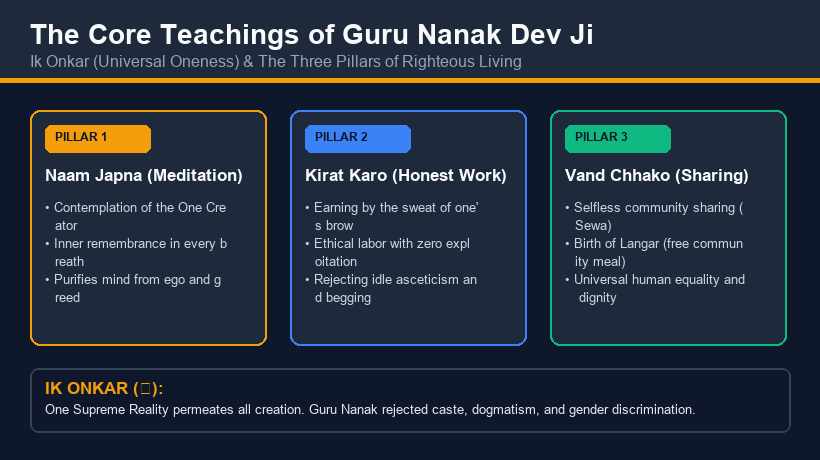
Ik Onkar (ੴ): Universal Divine Oneness
At the opening of the Mool Mantar in the Sri Guru Granth Sahib, Guru Nanak established the primordial truth: Ik Onkar—”There is Only One Universal Creator.”
By declaring that the divine light permeates every living being and the entire cosmos, Guru Nanak dismantled social barriers. If all humans share the same divine essence, then caste discrimination, ethnic supremacy, and gender inequality are spiritual falsehoods. Guru Nanak boldly declared: “Recognise the whole human race as one.”
The Three Pillars of Sikh Living
Rejecting idle asceticism and monastic renunciation, Guru Nanak taught that the highest spiritual path is lived as a socially responsible householder (Grasth). He formulated three practical principles:
| Pillar | Core Principle | Practical Application in Daily Life |
|---|---|---|
| 1. Naam Japna (ਨਾਮ ਜਪਨਾ) | Continuous Remembrance | Mindful meditation and living with gratitude, overcoming ego (Haumai), greed, and attachment. |
| 2. Kirat Karo (ਕਿਰਤ ਕਰੋ) | Honest Livelihood | Earning wealth through honest physical or intellectual labor, rejecting deceit, fraud, and exploitation. |
| 3. Vand Chhako (ਵੰਡ ਛਕੋ) | Selfless Sharing | Distributing wealth and resources to the needy; participating in Langar (free community kitchen) and Sewa. |
Langar and Radical Social Equality
To put Vand Chhako and human equality into daily practice, Guru Nanak founded the institution of Langar—the egalitarian community kitchen where kings and laborers, wealthy patrons and the impoverished, sit side-by-side on the floor (Pangat) to share the same vegetarian meal. Langar directly obliterated caste segregation and remains a global beacon of unconditional humanitarian service.
Furthermore, Guru Nanak was a fierce advocate for women’s dignity, challenging societal oppression in 15th-century India with his famous verse: “From woman, man is born; within woman, man is conceived… Why call her bad, from whom kings are born?”
The moral clarity of standing for human rights and ethical labor echoes through historical struggles and leadership legacies, much like the public commitments explored in our analysis of symbolic leadership and civic movements and community mentorship championed by leaders like Danielle Breezy.