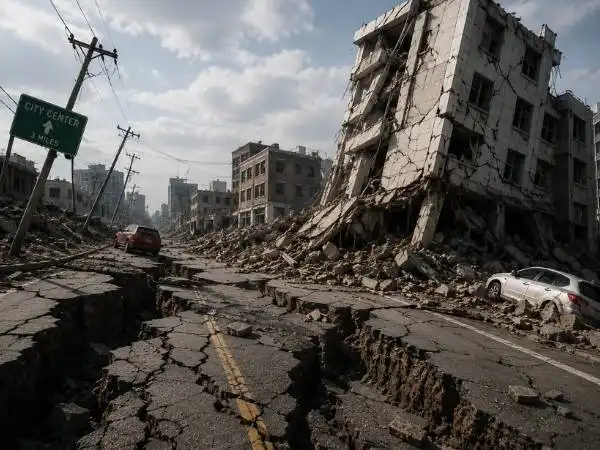

The ground beneath our feet feels permanent and unyielding, but the Earth is a dynamic, constantly moving planet. When that movement becomes sudden and violent, we experience an earthquake. Whether you live on a fault line or are just fascinated by the sheer power of nature, understanding why earthquakes happen and how to stay safe is critical.
In this comprehensive guide, we will dive into the science of seismic activity, explore how these massive energy releases are measured, look at recent global earthquake trends in 2026, and outline the most up-to-date safety protocols.
The Science Behind the Shake: Why Do Earthquakes Happen?
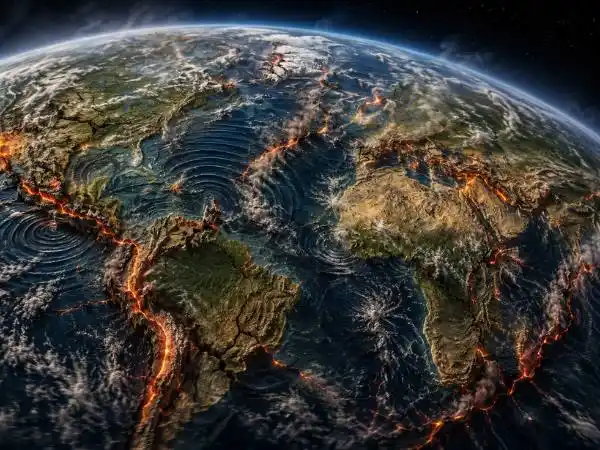
To understand earthquakes, we have to look beneath the surface. The Earth’s outer shell, or lithosphere, is not a single solid piece; it is broken up into massive puzzle pieces called tectonic plates. These plates are constantly moving, gliding over the softer, semi-fluid layer of the mantle beneath them.
Because the edges of these plates are rough, they often get stuck together while the rest of the plate keeps moving. This creates immense stress and friction at the boundaries, which are known as faults.
When the stress finally overcomes the friction, the rock breaks or slips, releasing massive amounts of stored energy in the form of seismic waves. This sudden release is the earthquake.
- Hypocenter (Focus): The exact point underground where the rock breaks and the earthquake originates.
- Epicenter: The point on the Earth’s surface directly above the hypocenter.
How Are Earthquakes Measured?
Scientists use specific scales to measure the size and impact of an earthquake. While many people are familiar with the “Richter Scale,” modern seismologists primarily use the Moment Magnitude Scale ($M_w$).
- Moment Magnitude Scale ($M_w$): This scale measures the total energy released by the earthquake. It is calculated using the distance the fault moved and the force required to move it. Because the scale is logarithmic, an earthquake of magnitude 6.0 releases roughly 32 times more energy than a 5.0.
- Modified Mercalli Intensity (MMI) Scale: While magnitude measures energy, intensity measures the effects of the earthquake on people, buildings, and the natural environment at a specific location. The MMI scale uses Roman numerals from I (not felt) to X (extreme).
Also Read : – The Top 10 Coldest Cities: How Do People Actually Survive?
Recent Significant Earthquakes in 2026
The year 2026 has already seen significant seismic activity globally. Monitoring these events helps seismologists understand fault stress and improve early warning systems.
- Tonga: On March 24, 2026, a massive magnitude 7.5 earthquake struck offshore near Vava’u, Tonga.
- Japan: On March 11, 2026, a devastating magnitude 8.7 earthquake, known as the Sanriku earthquake, occurred offshore of Aomori, resulting in extreme (MMI X) shaking.
- Myanmar/India Region: On January 27, 2026, a massive 7.6 magnitude earthquake struck Kachin, Myanmar, causing extreme shaking and significant casualties. Smaller, yet significant quakes, such as a magnitude 5.1 in Morigaon, Assam on January 5, 2026, were also widely felt in India’s North-East region.
- Bangladesh: On February 27, 2026, a magnitude 5.5 earthquake hit Bangladesh, with the epicenter located roughly 78 km east of Kolkata, making it widely felt in West Bengal.
Essential Earthquake Safety Guidelines (2026 Updates)
Being prepared is your best defense against an earthquake. Here are the official safety guidelines you need to follow:
Before an Earthquake
- Find out if you live in an area prone to earthquakes.
- Gather food, water, and medicine to stock up on preparedness kits.
- Heavy objects, glasses, and cutlery should be kept on lower shelves.
- Know the electric and water shut-off locations in your house.
During an Earthquake
- DROP, COVER, and HOLD ON: Drop onto your hands and knees, cover your head and neck with your arms (or get under a sturdy desk), and hold on until the shaking stops.
- If you are outdoors, stay in the open away from power lines or anything that might fall.
- If you are in a moving vehicle, stop as quickly as possible and stay in the vehicle.
- Do not use candles, matches, or other open flames.
After an Earthquake
- Check yourself and others for injuries and provide first aid for anyone who needs it.
- Check water pipes, electric panels, and fittings, and shut off main valves if damaged.
- Be prepared for aftershocks as these may strike.
By understanding the mechanics of how our planet moves and practicing proper safety protocols, you can significantly reduce the risks associated with earthquakes. Stay informed, stay prepared, and stay safe.
Also Read : – Strawberry Moons: Meaning, Myths, Science, and Why This Moon Still Feels Special
Frequently Asked Questions (FAQ)
What exactly causes an earthquake?
An earthquake occurs when rocks suddenly break and slip along a fault line in the earth.
This is driven by the slow movement and deformation of tectonic plates, which form the earth’s brittle outer layer.
When the immense stress building up between these moving plates exceeds the strength of the rocks, they snap, releasing stored energy as seismic waves that cause the ground to shake.Where do most earthquakes happen?
While earthquakes can occur all over the world, roughly 90% of them take place along the active fault lines that define major tectonic plate boundaries.
The most famous and highly active region is the “Ring of Fire,” which circles the Pacific Ocean.What are the different types of earthquake faults?
A fault is a fracture zone between two blocks of rock.
Earth scientists classify faults based on their angle and the direction the rocks slip.
“Dip-slip” faults move vertically (either normal or reverse), while “strike-slip” faults move horizontally past one another.Were there any major earthquakes in early 2026?
Yes, several significant seismic events occurred globally in the early months of 2026.
A massive magnitude 7.7 earthquake struck near Mandalay, Myanmar on January 27, 2026, rupturing a long section of the Sagaing Fault.
On February 27, 2026, a magnitude 5.5 earthquake hit Bangladesh at a shallow depth of 10 km, sending strong tremors through neighboring regions like West Bengal, India.
A magnitude 7.4 to 7.5 earthquake occurred off the coast of Japan on March 11, 2026, triggering tsunami advisories in the Tōhoku region and Hokkaido.
Additionally, a deep 7.5-magnitude earthquake was recorded near Tonga on March 24, 2026.What is the safest thing to do during an earthquake?
The most important rule is to stay calm.
If you are indoors, stay inside and immediately crawl under heavy furniture, like a sturdy desk or table, to protect yourself.
Avoid windows and outside doors, and instead stand against an interior wall near the center of the building if you cannot get under a desk.
If you are outdoors, move to an open area away from buildings, power lines, or anything else that might fall.