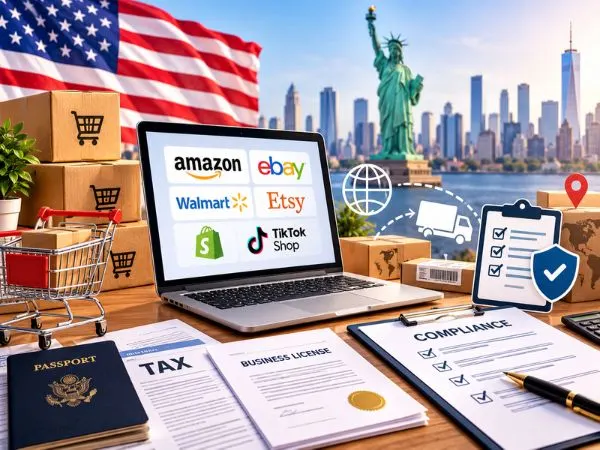

Selling physical goods to United States consumers gives access to the world’s largest and most active retail e-commerce market. Whether launching an independent direct-to-consumer brand or scaling an international export business, achieving long-term profitability requires clearing strict regulatory requirements, submitting proper tax paperwork, and selecting the optimal distribution channels.
1. Legal Documents & Identity Verification
You do not need to be a US citizen to sell to American buyers. Foreign founders can register directly under their domestic business entity or establish a US-based subsidiary (such as a Wyoming or Delaware Limited Liability Company).
Mandatory Seller Credentials
- Government-Issued Photo ID: Valid international passport or national identity card of the primary account owner/authorized signatory.
- Proof of Address: Bank account statement, credit card bill, or utility bill (electricity, piped gas, water) issued within the last 90 to 180 days with an exact name and address match.
- Business Registration Documents: Certificate of Incorporation, Partnership Deed, GST/MSME registration, or Trade License proving legal status in your home country.
- Export Clearances (For International Sellers):
- Import Export Code (IEC): Issued by your national foreign trade office (e.g., DGFT).
- Authorized Dealer (AD) Code: Registered via your business bank to process cross-border remittance earnings legitimately.
- Letter of Undertaking (LUT): To clear zero-rated export transactions without paying upfront domestic export tax.
- Internationally Chargeable Card: A credit or debit card enabled for foreign currency billing to pay platform subscription fees and ad budgets.
- Cross-Border Payout Account: A USD-denominated bank account or an approved digital virtual account (e.g., Payoneer, Wise, PingPong, or Mercury Bank).
2. Tax IDs & US Double-Taxation Treaties
Understanding federal tax documentation ensures you avoid unnecessary withholdings and penalties.
US Tax Documentation
- EIN (Employer Identification Number): A 9-digit federal tax identification number issued by the Internal Revenue Service (IRS). Non-residents without an SSN obtain an EIN by filing IRS Form SS-4.
- IRS Form W-8BEN / W-8BEN-E: Completed inside marketplace tax dashboards (such as Amazon Seller Central). It certifies that you are a non-US resident or foreign entity operating under bilateral Double Tax Avoidance Agreements (DTAA), preventing the default 30% US backup tax withholding on gross sales.
- Marketplace Facilitator Sales Tax: Most major US marketplaces (Amazon, Walmart, eBay, Etsy) automatically collect and remit consumer sales tax across nearly all 50 states on your behalf. Direct Shopify/WooCommerce sellers must track state economic nexus limits (commonly $100,000 in revenue or 200 annual orders per state) to register for state-specific sales tax permits.
3. Product Category Compliance & Agency Permits
Before shipping inventory to the US, verify that your items meet the specific requirements of the governing federal authority.
                           ┌── FDA (Cosmetics, Supplements, Packaged Food, Medical Devices)
                           ├── CPSC / CPSIA (Children's Toys, Sleepwear, Baby Gear)
US Port of Entry (CBP) ────┼── FCC (Bluetooth, Wi-Fi, Radios, Electronics)
                           ├── EPA / TSCA Title VI (Composite Wood, Chemical Products)
                           └── FTC (Textile Fiber Breakdown, Country of Origin Labeling)
- FDA (Food & Drug Administration):
- Cosmetics: Must comply with MoCRA (Modernization of Cosmetics Regulation Act), requiring facility registration, product listing, and safety substantiation.
- Dietary Supplements & Ayurvedic Goods: Must follow cGMP (21 CFR Part 111) manufacturing rules, include an English Supplement Facts panel, and avoid unauthorized medical/disease cure claims.
- Foreign Supplier Verification Program (FSVP): Importers of human food and supplements must designate a US-based FSVP agent to verify foreign food safety systems.
- CPSC (Consumer Product Safety Commission):
- Products intended for children under 12 require mandatory testing by a CPSC-accepted independent testing laboratory.
- Manufacturers or importers must generate a Children’s Product Certificate (CPC) certifying compliance with lead, phthalate, and safety hazard standards.
- FCC (Federal Communications Commission):
- Required for intentional or unintentional radio-frequency devices (wireless headphones, chargers, electronic gadgets) to prevent signal interference.
- Barcodes (GS1):
- Retail items require verifiable 12-digit UPC or 13-digit EAN barcodes registered directly through GS1.org. Marketplaces cross-reference GS1’s GEPIR database and reject unauthorized reseller codes.
4. Top Platforms to Sell Products in the USA
Different platforms cater to different fulfillment models, customer types, and margin expectations:
| Platform | Primary Strengths | Fee Overview | Fulfillment Type | Best Fit For |
| Amazon.com | Over 40% of all US online retail; access to 150M+ Prime shoppers. | $39.99/month + 8%–15% category referral fees. | Fulfillment by Amazon (FBA) or Merchant (FBM). | High-demand consumables, home goods, apparel, wellness. |
| Walmart Marketplace | Second-largest US marketplace; lower seller saturation, fast expansion. | 6%–15% referral fee; no monthly account fee. | Walmart Fulfillment Services (WFS) or seller-fulfilled. | Established brands with a track record of reliable fulfillment. |
| Shopify (D2C) | Total ownership over brand equity, customer emails, and profit margins. | $39–$399/month + 2.4%–2.9% + 30¢ gateway charges. | US 3PL warehouses (ShipBob, Deliverr) or air express. | Premium direct-to-consumer goods, specialty niches, recurring orders. |
| Etsy | High organic trust for creative and personalized merchandise. | $0.20 listing fee + 6.5% transaction cut. | Self-fulfilled via direct international air courier. | Handmade crafts, customized gifts, vintage items, artisan decor. |
| TikTok Shop US | Explosive social commerce conversion through influencer affiliate programs. | 6%–8% transaction fee. | US domestic 3PL fulfillment. | Trending impulse items, beauty, viral lifestyle novelties. |
5. Shipping & Customs Entry Blueprint
Moving physical products into the US follows one of two primary pathways:
Option 1: Direct-to-Consumer Parcel (Air Express)
- Logistics Providers: DHL Express, FedEx, UPS, or national postal express (EMS).
- Clearance Model: Section 321 De Minimis. Shipments valued at $800 or less per individual recipient per day typically clear US Customs duty-free and tax-free (provided they are not subject to strict Partner Government Agency controls like certain medical or agricultural goods).
- Pros & Cons: Minimal upfront warehousing costs, but high per-package air shipping fees and 4 to 8 business day transit times.
Also Read : – How to add my home in google map for public
Option 2: Bulk Freight & US Warehousing (FBA / 3PL)
- Logistics Providers: Ocean container freight (LCL/FCL) or commercial air cargo handled through a certified freight forwarder (Flexport, Freightos, or Amazon SEND).
- Clearance Model: Shipments valued over $2,500 undergo Formal Customs Entry (CBP Form 7501). This requires:
- An assigned Importer of Record (IOR).
- A Continuous Customs Bond (or Single-Entry Bond) purchased through a licensed customs broker.
- Proper 10-digit Harmonized Tariff Schedule (HTS) classification codes to assess import duties.
- Pros & Cons: Delivers competitive 1- to 2-day delivery badges (e.g., Amazon Prime) and low per-unit transport expenses, requiring higher initial working capital.
6. Practical Launch Sequence
- Category & Regulatory Validation: Ensure formulas, materials, and English packaging comply with US FDA, CPSC, or FCC regulations before mass production.
- Obtain GS1 Barcodes: Purchase genuine GTIN/UPC codes from GS1 for official catalog listings.
- Register Your Accounts: Open your seller portal (Amazon Seller Central, Walmart Marketplace, or Shopify) using verified business and identity documents.
- Secure Brand Protection: File your brand trademark with the USPTO (United States Patent and Trademark Office) to unlock Amazon Brand Registry, protect against copycats, and run rich A+ media content.
- Prepare Logistics & Inventory: Package items according to warehouse labeling rules (FNSKU barcodes and master carton labels), and ship inventory via your freight forwarder to a US fulfillment facility.
- Launch & Optimize: Enable targeted PPC advertising, collect early customer reviews, and monitor conversion metrics.
Frequently Asked Questions (FAQ)
Can I sell on Amazon USA without creating a US company?
Yes. Amazon allows foreign individual sellers and foreign registered businesses from approved countries to sell directly on Amazon.com using their domestic business licenses, passport, local credit card, and cross-border bank account.
Do I need a US bank account to receive payments?
You do not need a traditional brick-and-mortar US checking account. You can connect approved virtual banking services like Payoneer, Wise, PingPong, or Amazon’s built-in Currency Converter to convert USD earnings directly into your home currency.
When is product liability insurance required in the US?
If selling on Amazon.com, you must obtain commercial general liability insurance naming Amazon as an additional insured within 30 days after your gross monthly sales reach $10,000 for three consecutive months.