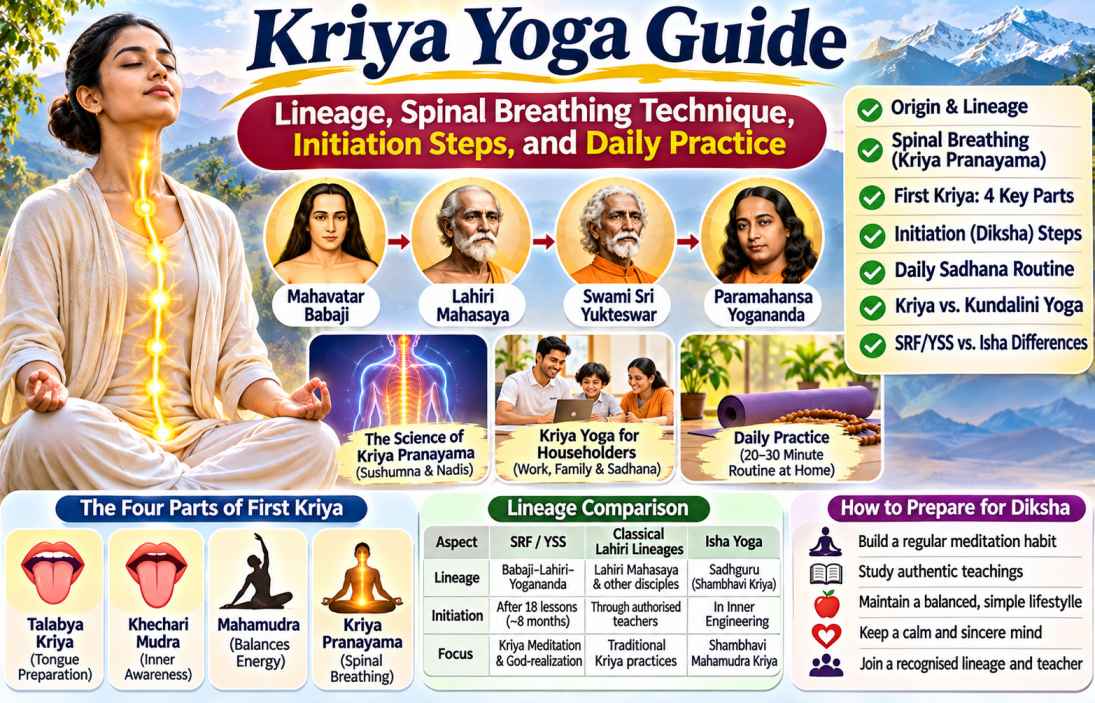

Kriya Yoga is a traditional meditation practice that combines breath awareness, concentration, and spiritual discipline. Its teachings have passed through several guru-disciple lineages in India.
Many people discover Kriya Yoga through Paramahansa Yogananda’s book Autobiography of a Yogi. Others learn about it through Lahiri Mahasaya, Mahavatar Babaji, or modern yoga organisations.
But there is one important detail. Kriya Yoga is not a single standard course taught in the same way everywhere. Different lineages preserve their own methods, preparation rules, and initiation processes.
This guide explains the history of Kriya Yoga, its connection with the spinal breathing method, the four commonly discussed components of First Kriya, and the process of receiving Diksha.
It also covers daily Sadhana for householders and the difference between traditional Lahiri Mahasaya Kriya Yoga and other modern practices.
What Is Authentic Kriya Yoga? (Origin and Lineage)
Kriya Yoga is a traditional yogic path associated with meditation, breath regulation, and spiritual development.
The word Kriya comes from the Sanskrit root related to action or activity. In yogic practice, it can refer to a purposeful method of spiritual discipline.
Authentic Kriya Yoga is usually taught through a recognised teacher or guru within a spiritual lineage. Students receive guidance on preparation, technique, concentration, and regular practice.
The aim is not simply to improve breathing or relax the body. Traditional teachings describe Kriya Yoga as a path towards self-realisation and deeper awareness.
The Sacred Lineage: From Mahavatar Babaji to Lahiri Mahasaya
The modern history of Kriya Yoga is closely linked with four spiritual figures:
- Mahavatar Babaji
- Lahiri Mahasaya
- Swami Sri Yukteswar Giri
- Paramahansa Yogananda
According to the traditional account preserved by Yogoda Satsanga Society of India (YSS), Mahavatar Babaji revived Kriya Yoga in 1861.
The meeting took place in the Dunagiri mountains near Ranikhet, Uttarakhand. Babaji initiated Lahiri Mahasaya into Kriya Yoga and asked him to share the practice with sincere seekers. (YSS: Mahavatar Babaji).
<AsyncImage query=”Mahavatar Babaji cave Dunagiri Dwarahat Uttarakhand Himalayan mountains spiritual site” aspectRatio=”16:9″ width=”100%”/>
Who was Lahiri Mahasaya?
Lahiri Mahasaya was born on September 30, 1828, in Bengal. He worked as a government employee and lived with his family in Varanasi.
His life became an important example for householders interested in spiritual practice. He showed that meditation and family responsibilities could exist together.
After receiving initiation from Babaji, Lahiri Mahasaya began teaching Kriya Yoga to people from different backgrounds. His disciples carried the teachings into several independent spiritual lineages.
One important disciple was Swami Sri Yukteswar Giri. He later became the guru of Paramahansa Yogananda.
Yogananda introduced the Kriya Yoga tradition to a wider international audience through his teachings, organisation, and Autobiography of a Yogi.
The YSS/SRF lineage follows this spiritual succession:
| Guru | Role in the Lineage |
|---|---|
| Mahavatar Babaji | Traditionally credited with reviving Kriya Yoga in 1861 |
| Lahiri Mahasaya | Shared Kriya Yoga with householders and other seekers |
| Swami Sri Yukteswar | Continued the teaching through his disciples |
| Paramahansa Yogananda | Established YSS and SRF and introduced the teachings internationally |
This history comes from the spiritual tradition. Independent historical records about Mahavatar Babaji’s life are not available, so the traditional account should be understood as a matter of spiritual belief. (YSS history).
Kriya Yoga for Householders vs. Monastics
One reason Lahiri Mahasaya became so important was his example as a householder yogi.
He did not leave his family or government work to follow a monastic life. He continued his daily duties and maintained a regular spiritual practice.
His example challenged the belief that deep spiritual practice required complete withdrawal from society.
Kriya Yoga for householders
Householders can practise within the limits of their daily responsibilities. A regular morning or evening meditation period can become part of their routine.
Common benefits sought by household practitioners include:
- Better control over attention.
- A regular meditation habit.
- Greater awareness of thoughts and emotions.
- A disciplined daily routine.
- Deeper spiritual study.
- A stronger connection with the chosen guru and tradition.
Kriya Yoga for monastics
Monastic practitioners may have more time for meditation, spiritual study, prayer, and group practice.
Their daily routine can include longer periods of meditation and service under the guidance of their organisation.
The main difference is the structure of daily life, not necessarily the spiritual goal.
Both householders and monastics need proper instruction. The exact method and daily practice depend on their lineage.
Lineage Variations: SRF/YSS, Classical Lahiri Lineages, and Isha
People searching for Kriya Yoga initiation often come across different organisations. Their names and techniques can create confusion.
The main distinction is their teaching lineage and method of transmission.
| Tradition | Teaching Background | Preparation and Initiation |
|---|---|---|
| YSS / SRF | Babaji → Lahiri Mahasaya → Sri Yukteswar → Yogananda | Structured home-study lessons followed by Kriya initiation |
| Classical Lahiri lineages | Different disciples and successors of Lahiri Mahasaya | Direct instruction through their respective authorised teachers |
| Hariharananda lineage | Babaji and Lahiri Mahasaya tradition through its own guru succession | Initiation by an authorised yogacharya |
| Isha Yoga | Sadhguru’s own teaching system | Shambhavi Mahamudra Kriya taught through Inner Engineering |
YSS and SRF
Yogoda Satsanga Society of India and Self-Realization Fellowship follow the same Yogananda lineage.
Their teaching system includes preparation, meditation lessons, and a formal initiation process.
YSS requires students to complete its 18 basic lessons before applying for Kriya initiation. The preparation period takes approximately eight months. (Official YSS Kriya lessons).
Classical Lahiri Mahasaya lineages
Several teachers preserve teachings connected with Lahiri Mahasaya and his disciples.
These lineages may differ in their explanations, terminology, preparatory exercises, and exact practice structure.
There is no single central authority that controls every Lahiri-based organisation. Students should check a teacher’s lineage, authorisation, and training background.
Isha Yoga
Isha offers a practice called Shambhavi Mahamudra Kriya through its Inner Engineering programme.
It is a distinct Isha teaching programme. It should not automatically be treated as the same initiation as Lahiri Mahasaya’s traditional First Kriya. (Official Isha programme).
Choosing a lineage is an important personal decision. Learn about its teacher, teachings, daily discipline, and initiation process before joining.
The Science and Mechanics of Kriya Pranayama
Kriya Pranayama is one of the best-known parts of traditional Kriya Yoga.
It involves breath regulation, attention, and inner concentration. In several Lahiri-based traditions, practitioners are taught to direct awareness along the spinal axis.
The practice has both spiritual and physiological aspects. These should not be confused.
Kriya Yoga Pranayama: Understanding Spinal Breathing
In traditional Kriya teachings, the spine plays a central role in meditation.
The practice refers to the upward and downward movement of attention and subtle life energy along the spinal axis.
Some teachings associate this path with the Sushumna Nadi, which is described as the central subtle channel in yogic philosophy.
The three commonly discussed Nadis are:
- Ida: Traditionally linked with the lunar or cooling aspect.
- Pingala: Traditionally linked with the solar or warming aspect.
- Sushumna: The central channel associated with spiritual awakening.
These are concepts from subtle-body yoga traditions. They are not anatomical structures that scientists have identified in the physical body.
How does spinal breathing work in traditional Kriya Yoga?
At a broad level, the practice involves:
- Sitting in a stable meditation posture.
- Bringing attention towards the spinal region.
- Following the breathing process with awareness.
- Using the method taught by the authorised teacher.
- Gradually developing deeper concentration.
- Remaining quietly aware after the practice.
The exact breathing method, mental focus, internal movements, and timing vary by lineage. They are taught during initiation or through the authorised lessons.
Do not try to recreate the full technique using online descriptions.
Decarbonising the Blood and the Stillness of Breath: Fact vs. Traditional Explanation
Some Kriya explanations use terms such as decarbonising the blood or reducing the body’s life-force activity.
These descriptions belong to traditional spiritual explanations. They should not be presented as established medical mechanisms.
From a physiological point of view, breathing affects oxygen intake, carbon dioxide removal, heart rate, and nervous system activity.
Slow and controlled breathing may influence autonomic activity and help some people feel calmer. Research reviews have found possible changes in heart rate and other measures after certain Pranayama practices.
But there is no strong clinical evidence that traditional Kriya Pranayama physically circulates air through the spine or removes carbon dioxide from the blood through subtle energy channels.
The spine does not function as a breathing tube. Lung ventilation and blood gas exchange take place through the respiratory and circulatory systems.
It is useful to respect the spiritual language of Kriya Yoga without treating every traditional description as a literal anatomical claim.
Kriya Yoga in Patanjali’s Yoga Sutras (Sadhana Pada 2.1)
Patanjali describes Kriya Yoga in the second chapter of the Yoga Sutras.
Sutra 2.1 states:
तपःस्वाध्यायेश्वरप्रणिधानानि क्रियायोगः
Tapah Svadhyaya Ishvara Pranidhanani Kriya Yogah.
It identifies three parts of Kriya Yoga:
| Sanskrit Term | Meaning | Practical Application |
|---|---|---|
| Tapas | Discipline and self-control | Maintaining regular spiritual practice |
| Svadhyaya | Self-study and study of spiritual teachings | Reading, reflection, and observing one’s thoughts |
| Ishvara Pranidhana | Surrender to the Divine | Devotion and trust in God |
These three principles form a foundation for spiritual discipline.
Tapas develops commitment and self-control. It encourages a person to follow a regular practice even when motivation changes.
Svadhyaya means studying yourself and learning from spiritual teachings. It includes reflecting on habits, thoughts, and actions.
Ishvara Pranidhana means surrendering to the Divine. It helps practitioners develop humility and devotion.
Patanjali’s definition is broader than the specific spinal-breath technique taught in Lahiri Mahasaya’s lineage. The same term, Kriya Yoga, appears in related but distinct historical and teaching contexts.
Classical Steps and Preparatory Practices: Mahamudra and Paravastha
Classical Lahiri-based Kriya traditions discuss several preparatory practices and internal techniques.
These include Talabya Kriya, Khechari Mudra, Mahamudra, and Kriya Pranayama. Some lineages teach other practices, such as Nabhi Kriya and Yoni Mudra, as part of their system.
The exact combination and order are not identical across all organisations.
The Four Commonly Discussed Parts of First Kriya
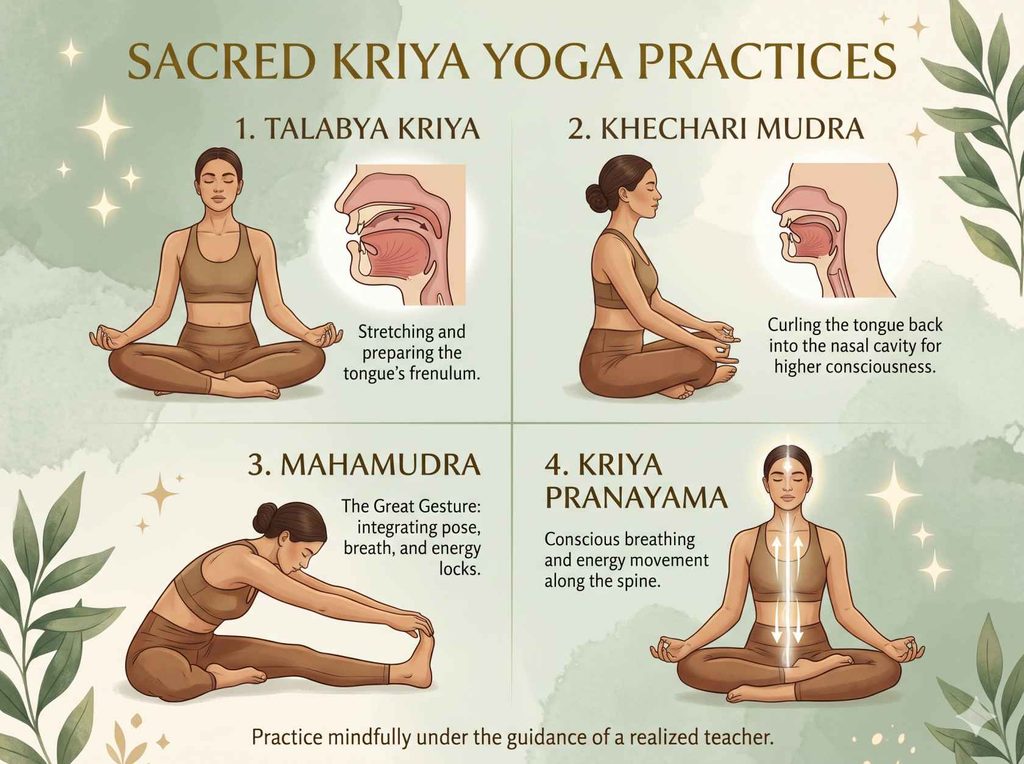
The following table explains the broad purpose of these terms. It is not a complete instruction manual.
| Practice | General Purpose in Traditional Teaching |
|---|---|
| Talabya Kriya | Preparatory practice associated with the development of Khechari Mudra |
| Khechari Mudra | Traditional mudra involving the tongue and inner awareness |
| Mahamudra | A yogic posture and internal practice used in Kriya traditions |
| Kriya Pranayama | Breath-based meditation with focused awareness along the spinal axis |
1. Talabya Kriya
Talabya Kriya is described in some Lahiri-based traditions as a preparatory exercise for Khechari Mudra.
It is associated with the tongue and its flexibility.
This exercise should not be treated as ordinary stretching. Follow the method prescribed by your teacher, and never force the tongue or surrounding tissues.
2. Khechari Mudra
Khechari Mudra is a traditional yogic practice involving the tongue.
Different yoga texts and lineages explain it in different ways. Some traditions treat it as an advanced mudra connected with internal concentration and Pranayama.
Its correct practice should be learned from a qualified teacher. Avoid cutting, injuring, or forcibly stretching the tongue.
3. Mahamudra
Mahamudra is a well-known practice in several Hatha Yoga and Kriya Yoga traditions.
It involves a specific body position and internal attention. Its form and purpose can differ between systems.
In Kriya Yoga, Mahamudra is commonly taught as part of preparation for meditation and Kriya Pranayama.
4. Kriya Pranayama
Kriya Pranayama is the central breath-based practice in many Lahiri-related systems.
It combines breathing, concentration, and internal awareness. Its exact method is traditionally passed through initiation.
The number of repetitions, breathing rhythm, mental focus, and other details should come from the teacher who initiated you.
What about Ketan Mudra?
The term “Ketan Mudra” is not a widely standardised name for one of the major practices across the Kriya lineages reviewed. Your teacher may have used a lineage-specific term or a different spelling. Confirm its exact name before adding it to a practice routine.
What Is Paravastha in Kriya Yoga?
Paravastha is a Sanskrit term used in some Kriya Yoga teachings for the state beyond the active practice.
It is generally described as a condition of inner stillness, absorption, and deeper awareness.
Rather than treating it as another physical exercise, some teachers explain Paravastha as a state that follows disciplined Kriya practice.
The way this term is taught can differ across lineages. Follow your own teacher’s explanation rather than mixing definitions from unrelated sources.
Kriya Yoga vs. Kundalini Yoga: Safety and Self-Regulation
Kriya Yoga and Kundalini Yoga have overlapping concepts in some traditional teachings. Both may discuss Prana, Nadis, Chakras, meditation, and spiritual awakening.
But their systems, practices, and methods are different.
| Feature | Kriya Yoga | Kundalini Yoga |
|---|---|---|
| Main focus | Breath-based meditation and inner awareness | Kundalini energy and spiritual awakening |
| Common practices | Kriya Pranayama, Mahamudra, meditation | Pranayama, Bandhas, Mudras, meditation |
| Teaching method | Usually through lineage-based initiation | Varies by tradition |
| Main concepts | Prana, Sushumna, concentration | Kundalini, Chakras, Nadis |
| Preparation | Depends on the lineage | Depends on the tradition |
Kriya Yoga is sometimes described as a gentle or scientific method. But this does not mean every technique is suitable for everyone.
Some practices involve internal locks, breath control, or prolonged concentration. These can cause discomfort when performed incorrectly or without proper preparation.
Do not force breath retention or attempt advanced energy practices without guidance.
People with uncontrolled blood pressure, heart conditions, respiratory conditions, or recent surgery should seek medical advice before beginning intense breathwork.
The safest path is gradual learning, correct instruction, and regular feedback from an experienced teacher.
How to Get Initiated (Diksha) and Build a Daily Sadhana Routine
Kriya Yoga initiation is called Diksha.
It is more than attending a general yoga class. It establishes a formal connection between a student and a spiritual teacher or lineage.
The process differs between organisations. Some provide written home-study lessons before initiation. Others arrange in-person programmes with an authorised teacher.
Preparing Mind and Body for Kriya Yoga Diksha
Preparation helps students develop the discipline needed for regular meditation.
The YSS/SRF tradition has a structured preparation programme. Students begin with basic lessons covering Energization Exercises, Hong-Sau concentration, and Aum meditation.
YSS currently requires students to complete 18 basic lessons before applying for Kriya initiation. These lessons take approximately eight months. (Official YSS initiation process).
Other Lahiri-based organisations may use different preparation methods.
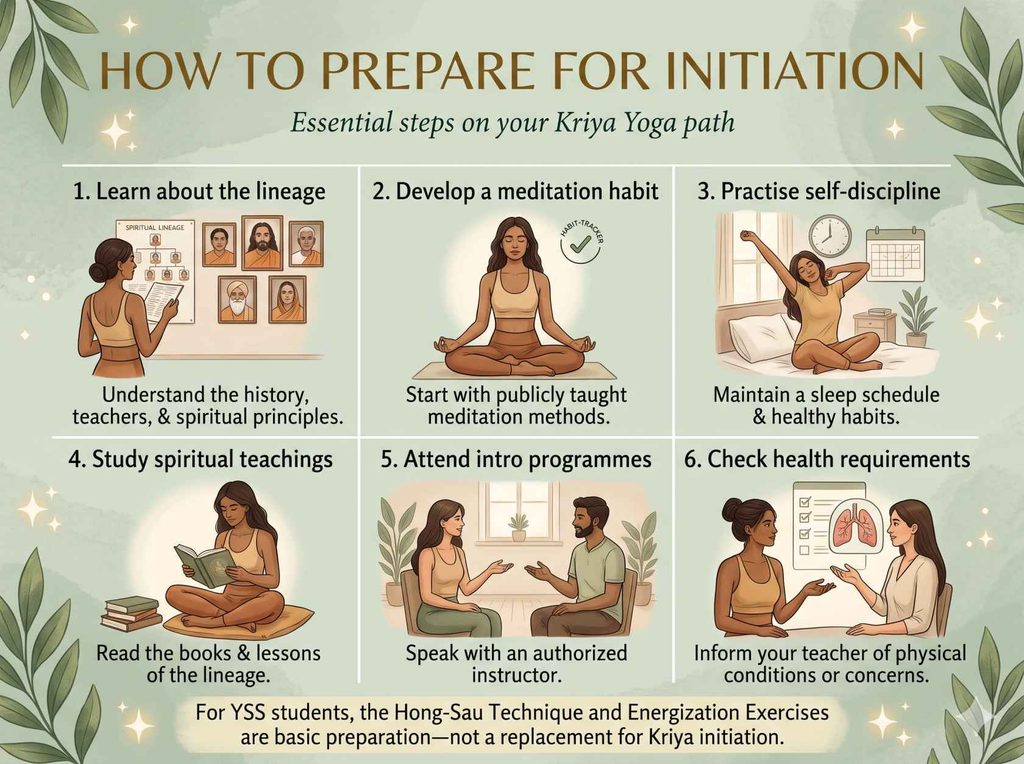
How to prepare for initiation:
1. Learn about the lineage
Understand the history, teachers, and spiritual principles of the organisation.
2. Develop a regular meditation habit
Start with a meditation method that is publicly taught by the organisation or recommended by its instructors.
3. Practise self-discipline
Maintain a regular sleep schedule, healthy daily habits, and a suitable meditation time.
4. Study spiritual teachings
Read the books and lessons recommended by the lineage. This helps you understand the purpose of Kriya practice.
5. Attend introductory programmes
Speak with an authorised instructor. Ask about preparation, initiation, follow-up sessions, and daily practice expectations.
6. Check the health requirements
Inform your teacher about relevant physical conditions or breathing difficulties. Do not hide health concerns during preparation.
For YSS students, the Hong-Sau Technique and Energization Exercises form part of the basic preparation. They are not a replacement for Kriya initiation.
How Does Kriya Yoga Initiation Work?
The exact Diksha process depends on the lineage.
For example, YSS has a home-study pathway with 18 basic lessons. Students who finish the required lessons can apply for Kriya initiation.
The Hariharananda lineage follows a different process. Its official website says initiation is given by Paramahamsa Prajnanananda or authorised yogacharyas. Its programmes include an introductory lecture, initiation, and supervised follow-up meditation sessions.
Before joining any programme, ask these questions:
- Who is the initiating teacher?
- Which spiritual lineage does the teacher follow?
- Is the teacher authorised to give initiation?
- What preparation is required?
- Are follow-up meditation sessions provided?
- What are the rules for daily practice?
- Is there a fee or suggested donation?
Avoid organisations that promise instant spiritual powers or demand large payments in exchange for guaranteed enlightenment.
Structuring a 20–30 Minute Daily Home Practice
A regular home practice can help householders maintain their spiritual routine.
But the time and sequence should match the method taught by your lineage.
If you have not received Kriya initiation, do not practise restricted Kriya Pranayama by copying online instructions.
For a beginner, a short meditation routine can include publicly taught preparatory practices.
Here is a simple time-management example:
| Practice | Suggested Time | Purpose |
|---|---|---|
| Settling and posture | 2–3 minutes | Prepare the body and mind |
| Gentle relaxation or approved preparation | 3–5 minutes | Reduce physical tension |
| Basic concentration practice | 5–10 minutes | Improve attention |
| Meditation or guided prayer | 5–10 minutes | Develop inner awareness |
| Quiet closing period | 2 minutes | End the session calmly |
This is a general beginner meditation structure, not an authorised First Kriya sequence.
If you are already initiated:
Follow your teacher’s prescribed Kriya routine. The correct order, repetitions, and duration take priority over a general 20–30-minute timetable.
Best Time to Practise Kriya Yoga
Early morning is a popular time for meditation. The surroundings are often quiet, and there are fewer interruptions.
Evening practice can work well for people with busy mornings.
Choose a time you can maintain every day. Avoid practising advanced breathing immediately after a heavy meal.
A few useful habits include:
- Use the same meditation space.
- Keep your posture comfortable.
- Reduce unnecessary phone notifications.
- Follow the instructions given during initiation.
- Do not increase practice duration suddenly.
- Record your routine if it helps with consistency.
- Attend group meditation when available.
Do not compare your meditation experience with another practitioner’s progress. Spiritual practice is personal, and each person develops at a different pace.
Frequently Asked Questions About Kriya Yoga
Who Started Kriya Yoga?
According to the traditional lineage, Mahavatar Babaji revived Kriya Yoga in 1861 and initiated Lahiri Mahasaya in the Dunagiri mountains. Lahiri Mahasaya then passed the practice to his disciples.
What Is Lahiri Mahasaya’s First Kriya Yoga Technique?
First Kriya in Lahiri-based traditions is associated with practices such as Talabya Kriya, Khechari Mudra, Mahamudra, and Kriya Pranayama. The exact structure varies by lineage, and the complete method is taught through initiation.
Can I Learn Kriya Yoga Without Initiation?
You can study its history and learn publicly available preparatory meditation practices. But traditional First Kriya techniques should be learned through the authorised teaching process of your chosen lineage.
How Long Does It Take to Get Kriya Yoga Initiation?
There is no universal waiting period. YSS currently requires completion of 18 basic lessons, which take approximately eight months. Other Lahiri-based organisations may have different requirements.
Is Kriya Yoga the Same as Shambhavi Mahamudra?
No. Shambhavi Mahamudra Kriya is a practice taught through Isha’s Inner Engineering programme. It is a separate teaching system and should not automatically be treated as Lahiri Mahasaya’s First Kriya.
What Is the Difference Between Kriya Yoga and Kundalini Yoga?
Kriya Yoga focuses on breath-based meditation and inner awareness through lineage-specific techniques. Kundalini Yoga focuses on practices associated with Kundalini energy. Their methods can overlap, but they are not identical systems.
Can Household People Practise Kriya Yoga?
Yes. Lahiri Mahasaya demonstrated that people could pursue spiritual practice while maintaining family and professional responsibilities. Householders can build a regular meditation routine according to their teacher’s instructions.
Final Thoughts: Follow the Right Kriya Yoga Lineage
Kriya Yoga has a long spiritual history connected with Mahavatar Babaji, Lahiri Mahasaya, Swami Sri Yukteswar, and Paramahansa Yogananda.
Its teaching has continued through different organisations and independent teacher lineages. Each may explain the techniques, preparation, and Diksha process in its own way.
Before receiving initiation, study the lineage and understand its daily requirements. Check the teacher’s authorisation and ask how follow-up guidance works.
Do not rely on online videos or written descriptions to learn advanced Kriya breathing. Proper instruction, patience, and regular practice matter more than rushing towards complex techniques.
For householders, even a short daily meditation session can build the discipline needed for a deeper spiritual path.
Start with preparation, choose your teacher carefully, and follow one lineage consistently.