

Updated on November 27, 2026
Direct Summary / Clinical Verdict: Miradone is an authoritative commercial brand formulation of Amiodarone Hydrochloride, a potent Class III antiarrhythmic medication prescribed strictly under specialist oversight for life-threatening cardiac arrhythmias. It is primarily indicated for refractory ventricular fibrillation (VF), unstable ventricular tachycardia (VT), and complex supraventricular arrhythmias that do not respond to first-line cardiac medications.
Because amiodarone possesses an extensive terminal elimination half-life (frequently 40 to 55 days) and accumulates extensively in adipose tissue and vital organs, treatment requires rigorous multi-system baseline screening and ongoing laboratory supervision as coordinated through a General Practitioner (GP) and primary care physician alongside a board-certified electrophysiologist.
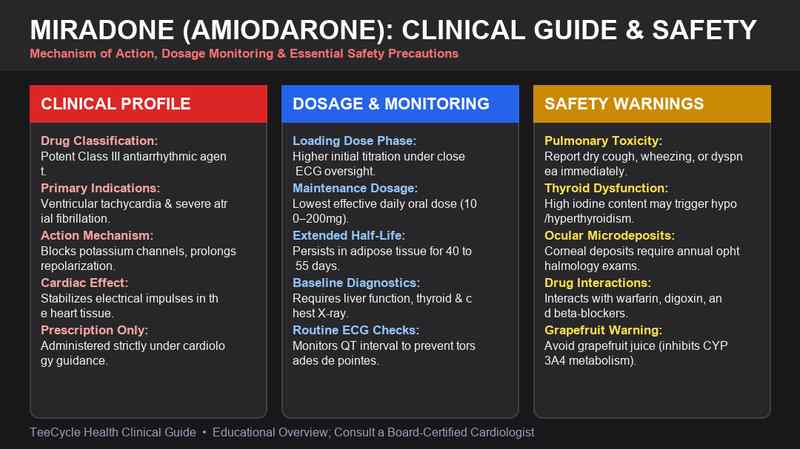
Mechanism of Action: How Amiodarone Regulates Heart Rhythm
Amiodarone exerts broad multichannel electrophysiological effects across heart tissue. Primarily categorized as a Class III agent, it inhibits voltage-gated potassium channels (specifically the rapid delayed rectifier current, $I_{Kr}$), which prolongs the cardiac action potential duration and effective refractory period in atrial, ventricular, and Purkinje myocytes.
Additionally, Miradone exhibits non-competitive alpha- and beta-adrenergic blocking properties (Class II effect), slows conduction through the atrioventricular (AV) node via L-type calcium channel inhibition (Class IV effect), and blunts inward sodium channels (Class I effect). This unique composite pharmacodynamic profile stabilizes erratic electrical wavefronts and prevents re-entrant tachyarrhythmias.
Dosage Titration & Clinical Administration Protocols
Due to the compound’s large volume of distribution and slow accumulation, clinicians administer Miradone using a tiered loading dose strategy before tapering down to the lowest effective maintenance dose:
- Initial Loading Phase: Typically 800 to 1,600 mg daily in divided doses for 1 to 3 weeks until initial therapeutic saturation or arrhythmia suppression is documented by telemetry.
- Intermediate Tapering Phase: Reduced to 600 to 800 mg daily for one month to solidify cardiac tissue saturation.
- Maintenance Phase: Usually stabilized at 100 to 400 mg once daily (most commonly 200 mg daily) to minimize organ accumulation while preventing arrhythmic recurrence.
Crucial Safety Precautions & Multi-Organ Monitoring
While remarkably effective at preventing lethal cardiac events, Miradone requires vigilant long-term surveillance because of potential adverse reactions across multiple organ systems:
- Pulmonary Toxicity: Chronic interstitial pneumonitis or pulmonary fibrosis can occur in 1% to 5% of patients. Any new-onset shortness of breath, non-productive dry cough, or pleuritic pain warrants immediate chest radiography and spirometry/DLCO testing.
- Thyroid Dysfunction: Each 200 mg tablet contains approximately 75 mg of organic iodine. This high iodine concentration can trigger either amiodarone-induced hypothyroidism (AIH) or thyrotoxicosis (AIT). Baseline and bi-annual Thyroid Stimulating Hormone (TSH) and free T4 assays are mandatory.
- Hepatic Oversight: Asymptomatic elevation of serum transaminases (AST/ALT) is common. Patients must avoid excessive alcohol consumption or hepatotoxic agents as discussed in clinical reviews on alcohol safety and liver metabolism guidelines. When liver enzymes rise to more than three times normal limits, dosage reduction or cessation is indicated. Supporting systemic organ health and liver recovery protocols are also thoroughly explored at integrative centers like Vardhan Ayurveda Hospital.
- Dermatological & Ophthalmic Effects: Prolonged sun exposure can cause photosensitivity and irreversible blue-gray skin discoloration (ceruloderma). Nearly all patients on long-term therapy develop benign corneal microdeposits, requiring baseline and yearly slit-lamp eye examinations.
| Monitoring Parameter | Baseline Requirement | Follow-up Frequency | Target Clinical Action |
|---|---|---|---|
| 12-Lead Electrocardiogram (ECG) | Prior to first dose | Every 3 to 6 months | Check PR and QTc intervals; avoid excessive QT prolongation (>500ms) |
| Thyroid Panel (TSH, Free T4) | Prior to first dose | Every 6 months | Detect drug-induced hypo- or hyperthyroidism early |
| Liver Function Tests (AST/ALT/ALP) | Prior to first dose | Every 6 months | Monitor for hepatotoxicity; adjust dose if >3x baseline |
| Chest X-Ray & Pulmonary Function | Prior to first dose | Annually or upon symptom onset | Rule out drug-induced pulmonary fibrosis or pneumonitis |
Frequently Asked Questions (FAQs)
What is Miradone used for?
Miradone (Amiodarone) is a prescription Class III antiarrhythmic medication indicated for severe, recurrent ventricular arrhythmias and refractory atrial fibrillation.
Why does Miradone cause blue-gray skin discoloration?
Prolonged sun exposure while taking amiodarone causes iodine-rich lipofuscin pigment deposits in dermal lysosomes, resulting in a slate-gray or blue skin tint (ceruloderma). Patients must wear broad-spectrum SPF and avoid tanning beds.
Can Miradone be stopped abruptly?
Never discontinue Miradone without cardiologist guidance. Because of its 40 to 55-day half-life, sudden stopping does not eliminate the drug immediately but can provoke dangerous rebound cardiac arrhythmias.